Cross Stream Sampler (CSS)
Overview
Features
Application
Software
Specifications
Overview
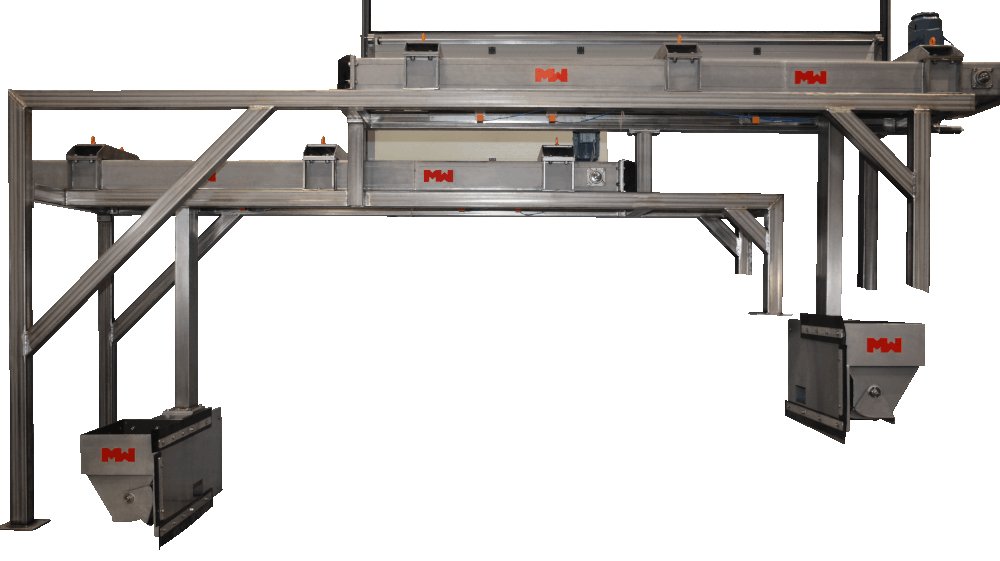
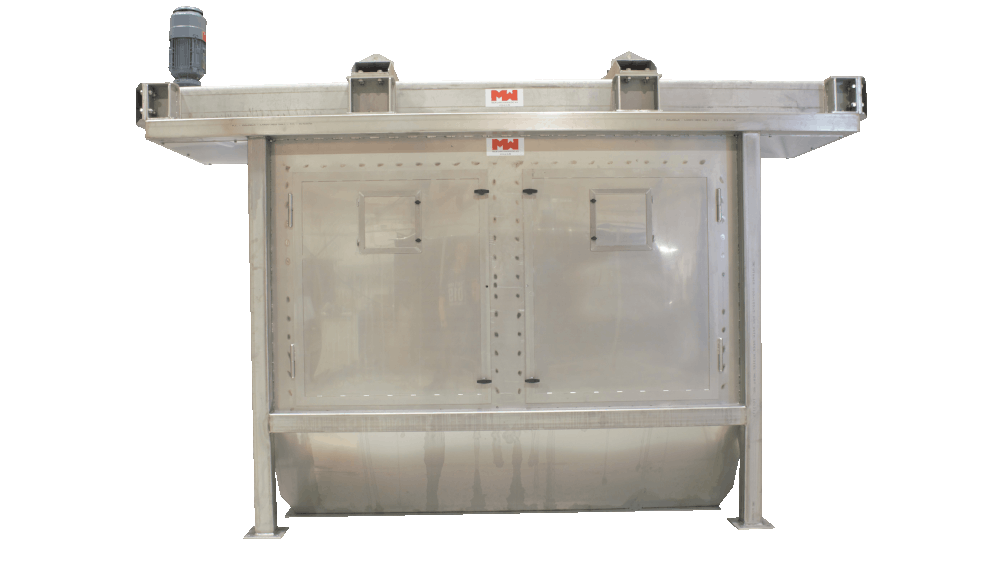
The Mark & Wedell Cross Stream Sampler (CSS) is engineered to extract a fully representative sample of bulk material from a free-falling stream, typically at the discharge point of a conveyor belt or transfer chute. Accurate quality control depends on true sample integrity, and the CSS achieves this by capturing a complete, unbiased cross-section of the entire material stream with each cut. Like our Cross Stream Cutter (CSC), this automated system removes the inconsistencies and safety risks that come with manual sampling in harsh industrial environments.
The Cross Stream Sampler is available in two variants to suit different operational requirements. The Cross Stream Sampler Chain (CSS-C) uses a heavy-duty chain drive, offering reliable performance across a wide range of materials. For environments with high concentrations of dust or fine particulates, the Cross Stream Sampler Wire (CSS-W) is the more suitable option. Its wire-driven mechanism reduces surfaces where dust can accumulate, resulting in smooth, low-maintenance operation with materials such as biomass and limestone powder.
Features
The Cross Stream Sampler (CSS) is:
- Theory of Sampling (TOS)-compliant which gives every particle in the stream an equal probability to be included in the extracted increment (the key to reliable sampling results).
- Enclosed in a cover housing to avoid cross-contamination between successive increments.
- Designed to be scalable, which makes it well suited for sampling from high-capacity Bulk Material Handling Systems (BMHS).
- Well suited for harsh environments and rough abrasive materials.
- Usable as a secondary/tertiary sampler as part of multi-stage sampling system.
Application
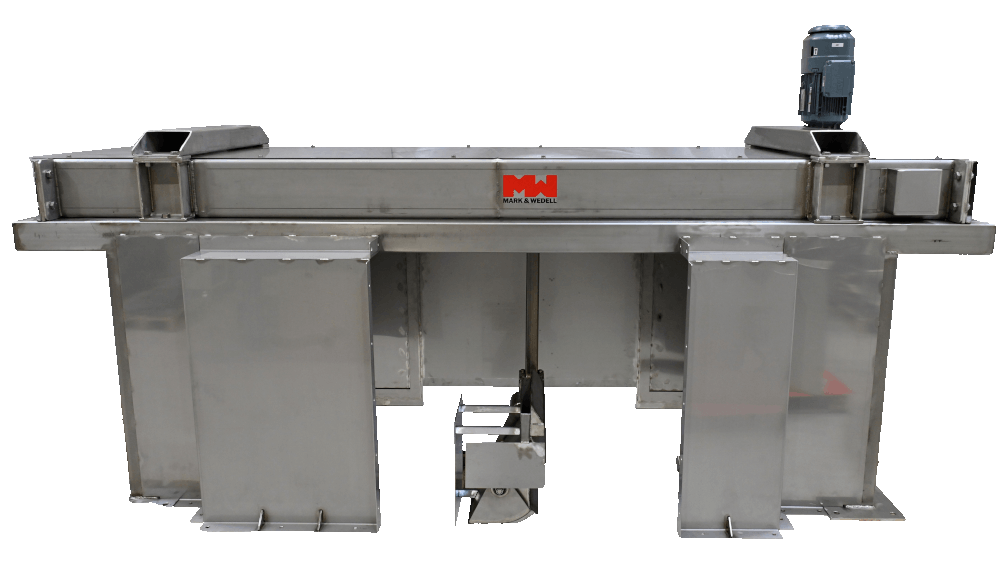
The CSS uses a railing system to translate a suspended bucket cutter fitted with a bottom-hinged discharge port. A chain or wire drive connects to a gear motor mounted at the top of the rails, controlling the cutter at a constant cutting speed of up to 0.6 m/s as it takes a transverse increment from the falling material stream.
The unit is enclosed in a cover housing to prevent contamination, with hatches on the top and side providing easy access for inspection and cleaning.
When not in use, the cutter parks above the sample discharge port to prevent non-sampled material from entering. When an increment is requested, the carriage first passes through the material stream with the discharge port open, allowing process material to flow through unaffected. At the turning point, the discharge port closes and the cutter collects the sample on the return pass. The cutter accelerates and decelerates to and from its constant cutting speed well outside the active sampling zone. Once parked, an activator opens the discharge port and releases the extracted increment.
Typical increment volumes range from 25 to 100 litres.
Software
The sampler can be supplied with or without a control cabinet to exchange signals with the clients DCS (Distributed Control System) or SCADA (Supervisory Control and Data Acquisition).
Specifications
| Housing | Stainless Steel AISI 304/316 or painted carbon steel |
| Railing System | Stainless Steel AISI 304/316 or painted carbon steel |
| Cutter | Stainless Steel AISI 304/316 or painted carbon steel with Hardox impact plate |
| Motor | SEW or equivalent |
| Local Control Box | Stainless steel or painted steel, containing Motor feeder, frequency converter, PLC and interface for external communication. |
| Options |
|