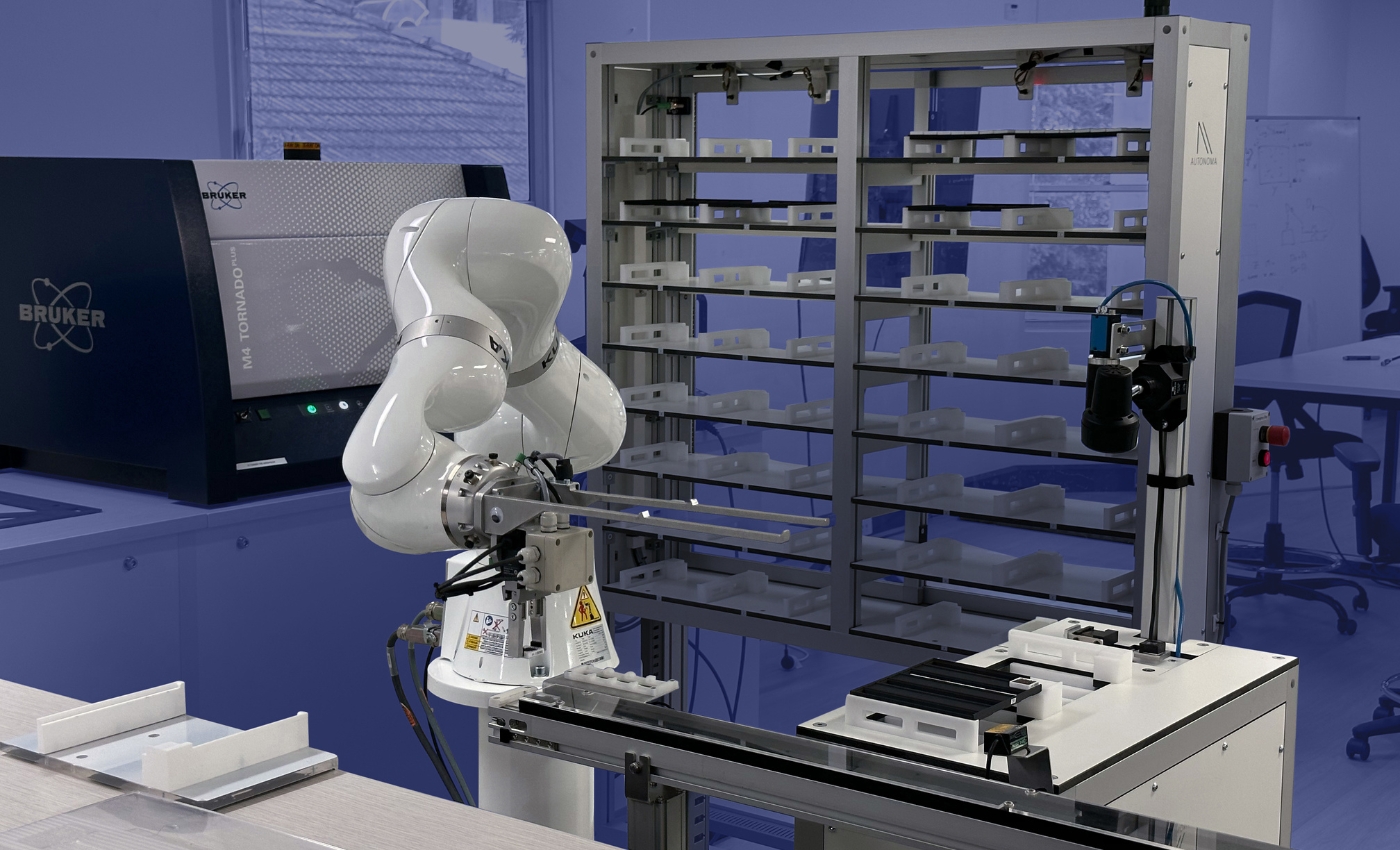
WesTrac Next Gen Laboratory Project (NGLP)


The WesTrac Next Gen Laboratory Project (NGLP) is a fully integrated, walkaway automated sample preparation and analysis line delivered by AUTONOMA. Ten coordinated laboratory modules are orchestrated by a centralised Cartesian Linear Robot, creating an end to end, barcodedriven workflow from tray intake through aliquoting and particle counting to orderly output and reruns.
Operators simply prepare and register trays of bottles in the LIMS, dock a wheeled tray trolley, lock it in place, and press Start—the system takes care of the rest.
At a Glance:
- 10 automated modules linked by a central Linear Robot
- Endtoend traceability via barcode validation and Labware LIMS integration
- Walkaway operation: operators load trays, press Start, and focus on highervalue work
- Builtin buffering to avoid instrument bottlenecks
- Optimised contamination control with heightsensing pipetting and segregated lids
- Modular architecture with dual Decapping & Aliquoting lines for throughput
The Challenge:
WesTrac required a robust, scalable automation platform to streamline sample handling and preanalytical workflows for highthroughput laboratory operations. Key objectives included:
- Reducing manual touchpoints and operator time
- Enforcing LIMSdriven traceability from intake to output
- Minimising crosscontamination risk during aliquoting
- Balancing throughput with instrument availability
- Enabling repeat testing without disrupting the main line
The AUTONOMA Solution:
AUTONOMA delivered a modular automation line that standardises and derisks sample handling. The Linear Robot coordinates a set of specialised modules—covering PQ analysis, mixing, decapping, aliquoting, dilution, test tube sorting, rack population, and particle counting—while maintaining full visibility and control through LIMS integration and barcode validation at each critical step.
End-to-End Workflow:
Tray Registration & Staging
Operators prepare trays of bottles and register them in the LIMS. Trays are placed into a wheeled tray trolley for bulk transfer.
Dock, Lock & Start
The operator docks and mechanically locks the trolley to the automation cell, then presses Start and walks away.
Tray Pickup & Validation
The Linear Robot lifts an entire tray, scans the tray barcode, and verifies it against the LIMS.
- Valid: processing begins.
- Invalid: the tray is returned to the trolley for operator intervention.
Lightning PQ Analysis
The tray is routed to the Lightning PQ module for ferrous debris/PQ analysis.
Tumbling & Homogenisation
The tray is placed in the Tumbler Mixer, which rotates endoverend for a predefined duration to homogenise samples.
Decapping & Lid Handling
Mixed trays are delivered to one of two Decapping & Aliquoting Modules. One bottle at a time is picked and placed on a decapper transport. These modules can each process more than 1500 sample bottles per 24 hours.
- The bottle is decapped.
- The lid is inverted and placed into a separate, matched lid tray for clean, traceable output pairing.
Precision Pipetting & Aliquoting
A pipetting robot measures the liquid height in the bottle and immerses only the pipette tip to minimise dripping and crosscontamination.
- Up to three aliquots per sample: Viscometry, FTIR, and ICP.
- The ICP tube is automatically diluted with solvent to the required ratio before analysis.
Automated Tube Handling & Rack Population
Prior to filling, operators have loaded empty test tube racks. A Test Tube Sorter lets operators loosely pour tubes into a hopper; tubes are automatically sorted, oriented, and presented to the automation.
- The XYZ robot arm transfers filled aliquot tubes to their respective racks (Viscometry / FTIR / ICP).
Particle Counting
After aliquoting, the sample bottle is transferred to the PAMAS Particle Counter for analysis.
- If instruments are busy, trays are buffered until available, ensuring continuous system flow without bottlenecks.
Orderly Output & Reruns
Post-analysis bottles are returned by the Linear Robot to an output trolley.
- The matched lid tray is placed alongside the correct bottle tray.
- Operators remove full trolleys when ready.
- Repeat testing is supported: specific bottles can be manually reloaded for targeted tests or alternative preparation steps.
Key Modules
- Trolley Dock & Tray Barcode Validation
- Lightning PQ Modules x 2
- Tumbler Mixers x 2
- Decapping & Aliquoting Modules x 2
- PAMAS Particle Counters x 3
All modules are orchestrated by the central Cartesian Linear Robot and tightly integrated with the Labware LIMS for sample identity, routing, and status.
Software & Integration
- Labware LIMS Integration: Full tray/bottle verification, chainofcustody, and status updates
- BarcodeDriven Routing: Automated validation and exception handling
- Instrument Handshakes: PQ, PAMAS, and downstream analytics aligned via robust I/O
- Buffer & Retry Logic: Intelligent queuing prevents idle time and maintains throughput
- Auditability: Action logs for trays, bottles, aliquots, and instrument events
Contamination Control & QA
- Liquid height measurement before pipetting to limit immersion depth and prevent wicking
- Isolated lid handling with inverted placement in matched trays
- Postmixing aliquots ensure better representativity
- Defined dilution protocols for ICP to standardise preparation
- Barcode checks at critical transitions reduce misrouting risk
Operator Experience & Safety
- True walkaway: dock, lock, start—automation handles the rest
- Ergonomic loading via wheeled trolleys and bulk tube hopper
- Interlocks at trolley dock and guarded robot zones
- Clear prompts for invalid trays or required interventions
- Easy reruns without disrupting the main line
Benefits & Outcomes
- Higher throughput with parallelisation (dual decapping/aliquoting lanes)
- Consistent quality through standardised mixing, pipetting, and dilution
- Reduced manual handling via automated sorting, transfer, and rack population
- Improved traceability with full LIMS integration and barcode validation
- Less downtime thanks to buffering and intelligent scheduling
- Scalable architecture—modules can be upgraded or expanded as needs evolve
System in Action (Typical Cycle)
- Load registered trays → dock trolley → press Start
- Linear Robot validates tray → PQ → mix → decap
- Heightsensed pipetting → aliquot to 3 tubes (Viscometry / FTIR / ICP)
- ICP tube autodiluted → tubes placed into dedicated racks
- Bottle → PAMAS particle counting → output trolley with matched lids
- Remove full trolley → optional rerun for selected bottles/tests
Ready to Extend
The NGLP platform is built for growth. Additional analytical modules, expanded buffering, and enhanced data pipelines can be added without rearchitecting the line—preserving uptime while increasing capability.
Discover how WesTrac’s Next Gen Laboratory Project (NGLP) is revolutionising oil and coolant fluid condition monitoring, delivering faster insights, improved reliability, and smarter maintenance outcomes. Watch the full story here: https://www.youtube.com/watch?v=FYA4uqyBlVc”